In This Guide
- The Short Answer
- What Are Paver Lights, Step Lights and Wall Cap Lights?
- Why Is It Easier to Plan Lighting Into a Hardscape From the Start?
- What Should You Plan Before the Build, Fixture by Fixture?
- Which Fixture Goes Where? A Quick Decision Guide
- What Is the Problem Nobody Mentions About Built-In Lights?
- Where Do Paver Lights Make Sense, and When Should You Skip Them?
- A Hypothetical Walkthrough: Lighting Planned Into a Patio and Seat Wall
- Frequently Asked Questions
- Can you install paver lights after the patio is built?
- Can paver lights go in a driveway?
- Can you put paver lights near a pool or spa?
- How do you replace a light under a retaining wall cap?
- How are paver lights different from stake-mounted path lights?
- What affects the cost of lighting built into pavers and walls?
- What should you ask an installer before building lighting into a hardscape?
- Plan Your Paver Lights Before the Stone Goes Down
Direct Answer: Paver lights, step lights and wall cap lights work best when you plan them with the hardscape, because cable routes, channels and mounting spots are far easier to build in than to retrofit, though adding them later is still possible.
Ask ten people what “paver lights” means and you will get several answers. Some mean a brick-shaped fixture that takes the place of one paver. Others mean a small round light set into a paver. A few mean puck lights, well lights or even stake-mounted path lights. The names overlap, and that confusion causes real planning mistakes.
The bigger mistake is timing. Lighting that gets added after the stone is down has to find a way around it. Lighting that gets planned with the stone has a place waiting for it.
This guide covers three things: what each fixture type actually is, what to decide before the build starts, and the one downside of built-in lights that most articles skip. If you are weighing a patio, stairs or a seat wall right now, you can contact our team and bring lighting into the first conversation.
What Are Paver Lights, Step Lights and Wall Cap Lights?
Paver lights are small low-voltage fixtures installed flush with a paved surface, step lights sit in the riser of a stair or under its cap, and wall cap lights tuck under the cap of a seat wall or retaining wall. All three belong to the broader category of hardscape lighting, meaning lights built into stone, block and concrete rather than staked into soil.
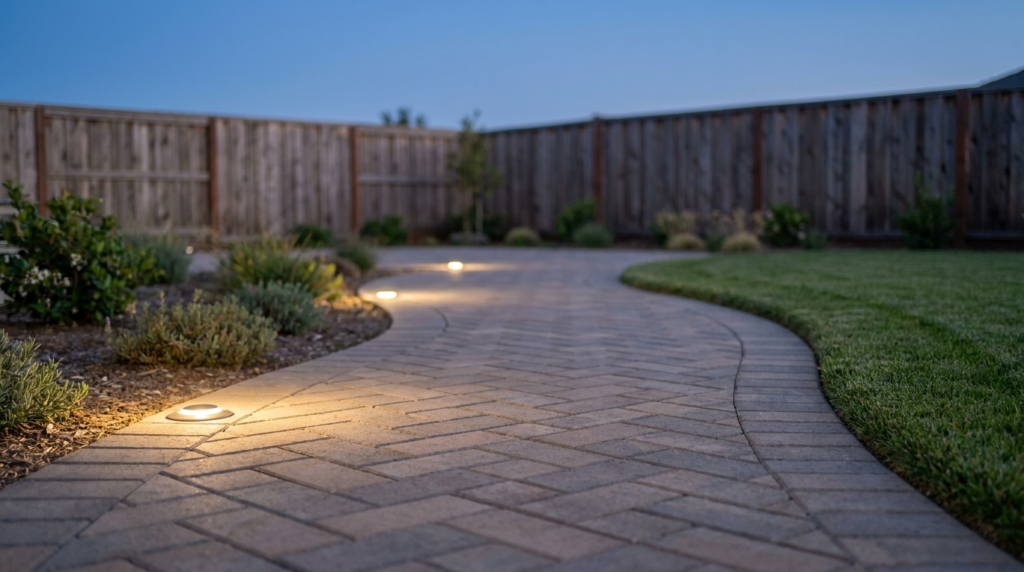
A 2010 trade article in LCDBM describes in-paver lights as fixtures that are typically positioned in a border to define an area. Some designs are brick-shaped units that replace a paver in the pattern. Others are small round fixtures that install directly into a paver, flush with the surface. Both approaches are called paver lights in everyday talk, so ask which kind you are being quoted.
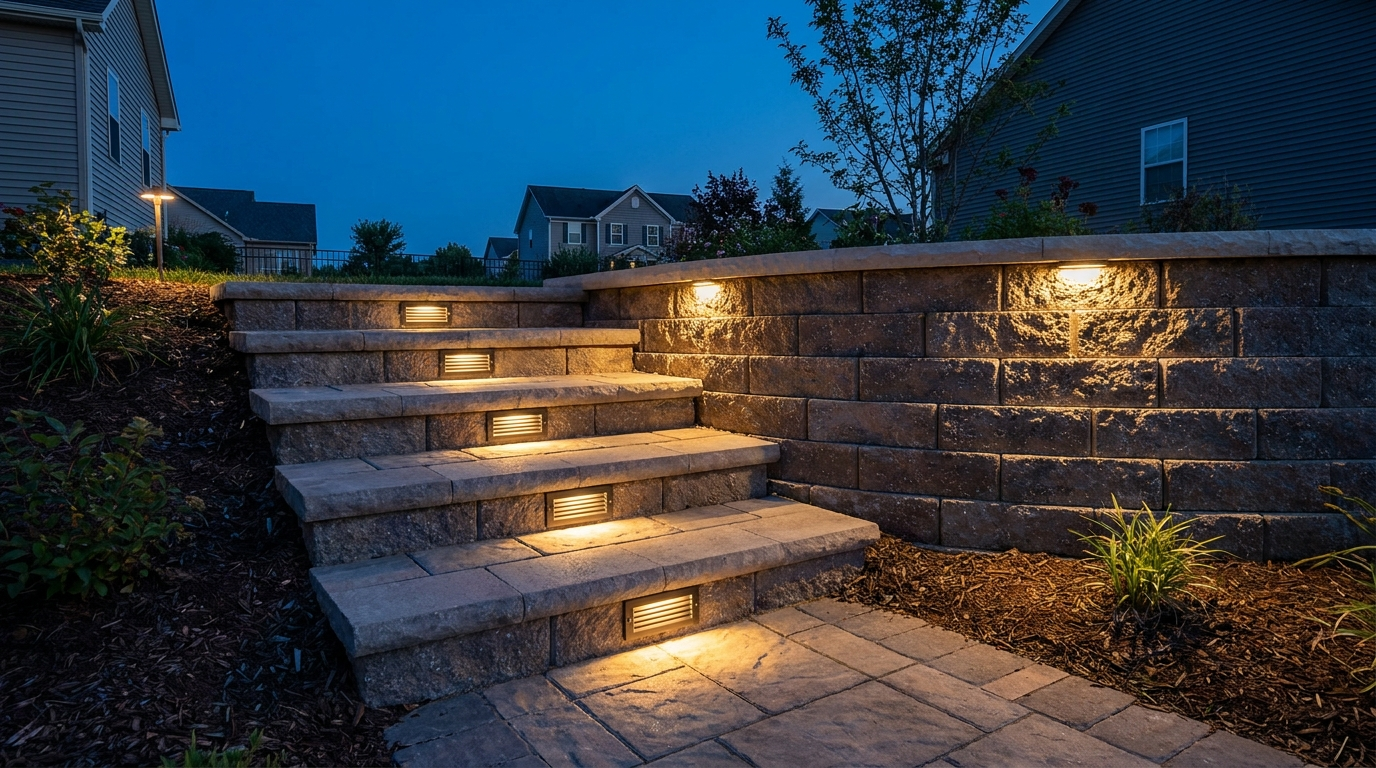
Step lights solve a different problem. They put light on the tread where your foot lands. A 2004 landscape trade article by LCN notes that step lights often include louvers, which limit glare and aim the light at the step. Wall cap lights do the same job for seat walls and retaining walls: they wash the surface below the cap with a soft downward glow.
Why Is It Easier to Plan Lighting Into a Hardscape From the Start?
Planning together is easier because the spots that hold lighting, such as cable paths, channels, boxes and mounting points, are still open before stone and concrete close over them. Kichler, a lighting manufacturer, says in its hardscape lighting basics guide that designing and installing the hardscape and the lighting at the same time is much easier than lighting a finished hardscape.
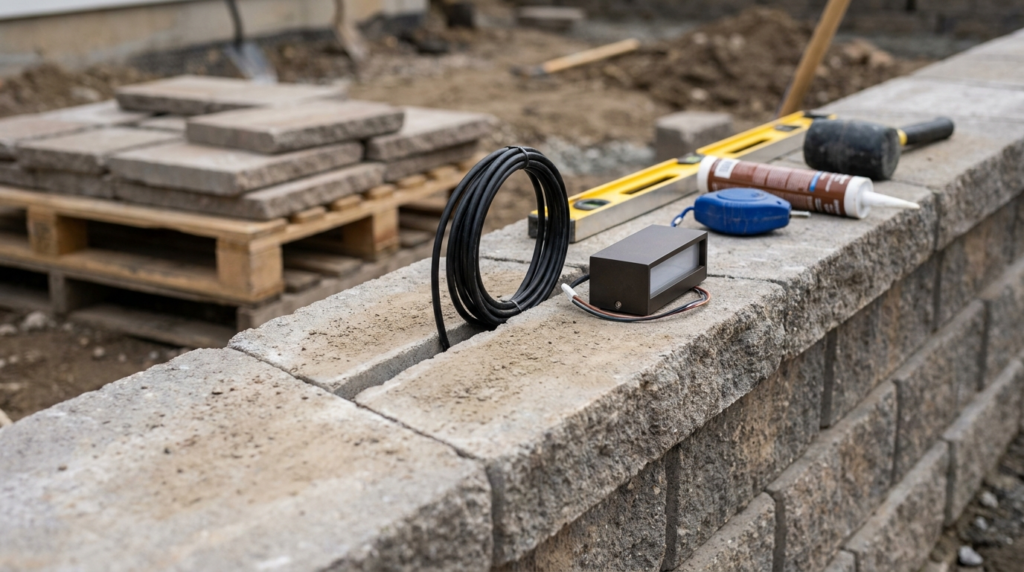
Here is what that looks like in practice. For wall lights, the fixture normally goes in before the cap. You may need to ask the hardscape crew to leave a channel for the cable. You also want extra cable slack, so a fixture can be pulled out for service later.
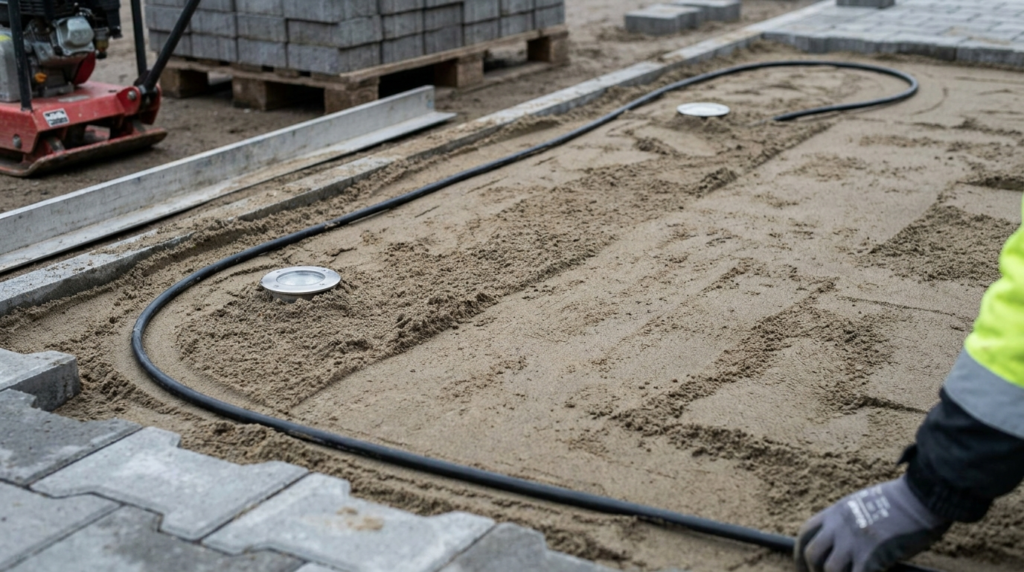
For paver lights in a patio or walkway, the LCDBM article describes laying the cable flat on the sand bed in a continuous loop around the perimeter, starting and ending at the power source. The fixtures sit close to the cable, but not directly on top of it. Polarity matters at the splices.
Now the honest part. Easier together does not mean impossible later. The same LCDBM article explains that existing pavers can be retrofitted: installers extract pavers, drill the ones chosen for fixtures and route the cable. A paver supplier’s how-to guide for seat walls says that in an existing wall you remove the capstones first and grind the blocks so lights sit flush. A wall-light manufacturer says its fixtures can be added after the fact if the block or capstone can be pried up.
So the rule is simple. Planned together, it is a design decision. Added later, it is a repair-style job. Both work, but they are not the same amount of effort.
Voltage, transformer sizing and electrical code are separate topics. Our guide on landscape lighting in the Bay Area explains how the full lighting system fits together, so this article stays focused on the stone and block side.
What Should You Plan Before the Build, Fixture by Fixture?
You should plan the cable route, the access for service and the exact mounting spot for each fixture type before construction begins. The details differ for paver lights, step lights and wall cap lights, so take them one at a time.
Paver lights in patios and walkways
Decide where you want light, then let the installer confirm the layout against the paver pattern. A landscape trade article on installing lights in a hardscape points out that you cannot put a light where a paver is cut, so final positions are easier to choose once the layout is set. The same article describes filling any voids around the fixtures.
Keep the cable route in the plan from the start. Ask whether lights will be spaced for an even look along a border or grouped for accents. Ask, too, how the cable loop will be recorded for later.
Step lights in stairs
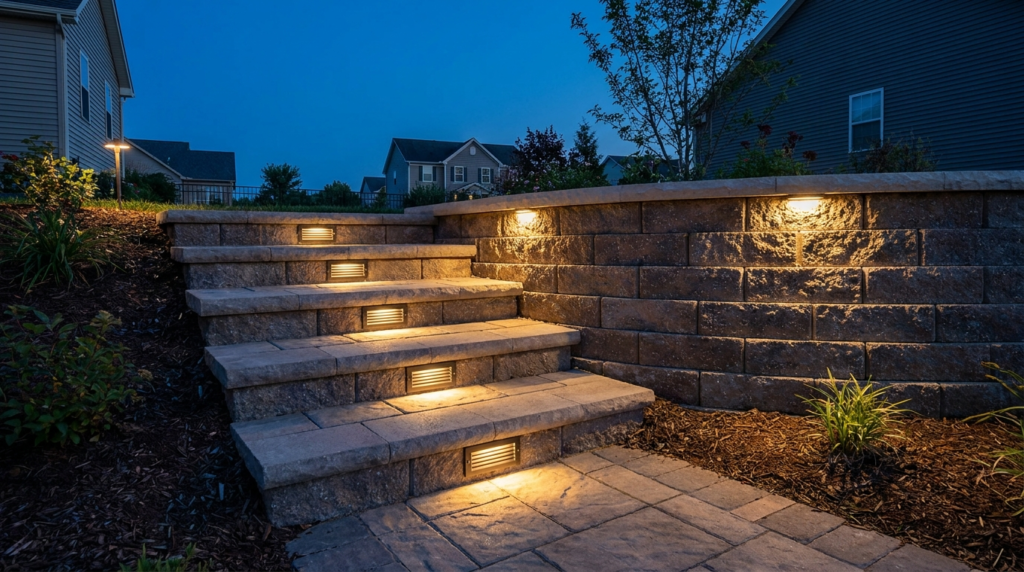
Plan the light position when the stair form is designed. The LCN article describes fixtures that can be built into a wall or into the riser of stone steps. For poured concrete, the boxes and PVC conduit are fixed to the forms before the pour and protected from slurry and wet concrete. The cable and the fixture face go in afterward.
For paver stairs, Kichler describes step light placement in the riser or under the cap. Ask the installer which approach fits your stair and how a failed fixture would be reached.
Wall cap lights in seat walls and retaining walls
Ask for the fixture to go in before the cap, with a channel for cable and a slack loop for service. The paver supplier’s how-to guide also suggests setting the capstones in place dry, without glue, to check fit before you glue them one at a time. That small step saves a lot of trouble when fixtures need extra room.
Which Fixture Goes Where? A Quick Decision Guide
The right fixture depends on the surface and on what you want the light to do. This table summarizes the three types covered here, using what the trade sources above describe.
| Fixture type | Where it goes | What to plan before the build | Question to ask your installer |
|---|---|---|---|
| Paver light | Flush in a paved surface, often along a border | Cable route on the sand bed, fixture spots away from cut pavers, polarity at splices | What is this fixture’s load rating, and how far should it sit from a pool or spa? |
| Step light | In the riser of a step, or under its cap | Boxes and conduit set in the forms for poured steps, plus louvers to limit glare | How will I reach this fixture if it fails? |
| Wall cap light | Under the cap of a seat wall or retaining wall | Fixture before the cap, a channel for cable, slack for service | Can the cap be lifted later without damaging the wall? |
Print this table and bring it to your next site visit. If you want to talk through your own yard, you can reach out to our team, and our outdoor lighting page shows the broader lighting services we list.
What Is the Problem Nobody Mentions About Built-In Lights?
Built-in lights sit behind stone or concrete, so a failed fixture can turn into a small construction project. A lamp in a stake light takes seconds to swap. A light embedded in pavers or under a wall cap may not.
The cause is mechanical. A fixture held in place by surrounding material can only be reached by moving that material. A published patent filing on paver lights notes that many existing designs require removing several adjacent pavers to replace the light, then releveling the area. Some designs let you swap the lamp module or lens without lifting the paver. Others do not.
You can reduce the problem with a few planning choices:
- Leave cable slack at each fixture so it can be pulled out for service.
- Choose serviceable fixtures where the light module or lens can be replaced without disturbing the stone.
- Map the cable runs with photos and measurements before the surface is closed.
- Use conduit where the construction allows it.
- Keep spare parts that match the fixtures you installed.
Before you sign off on a design, ask one question: “How will I replace a fixture if it fails, and where are the cable runs recorded?” A clear answer tells you the plan was thought through.
Where Do Paver Lights Make Sense, and When Should You Skip Them?
Paver lights make the most sense along edges and transitions where people walk after dark: stairs, borders, seat walls and low retaining walls. They are less useful when you only need a single point of light. These scenarios are illustrations, not specific projects.
- A paver staircase on an Oakland hillside: step lights in the risers put light where each foot lands.
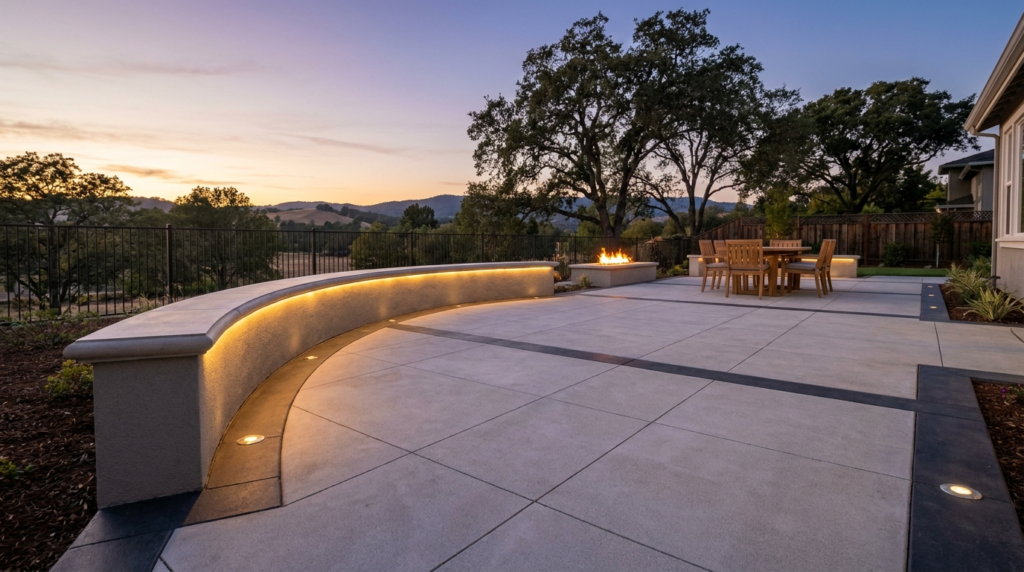
- A seat wall around a fire feature in Walnut Creek: wall cap lights give the seating area a soft glow without a fixture on the patio surface.
- A retaining wall along a driveway in Danville: lights under the cap define the wall line. Our retaining walls page covers the wall side of that work.
- A pool deck in San Ramon: possible, but only after confirming how far fixtures and the power source must stay from the water. Older trade guidance advises keeping them well back from pools and spas, and rules may have changed, so ask.
Skip built-in lights, or at least pause, in these cases:
- Existing pavers in good shape where a retrofit would mean extracting many pavers.
- A single point of light, where a stake-mounted path light solves it with far less disruption.
- Driveways where the fixture’s load rating is unknown. Some manufacturers rate certain units for passenger car or light commercial vehicle loads, but not every fixture is built for that.
A Hypothetical Walkthrough: Lighting Planned Into a Patio and Seat Wall
This is an illustration, not a client story. Picture a paver patio with a seat wall on a Bay Area lot, planned with lighting from day one.
Before excavation, you walk the site at dusk with the installer and mark where you want light: the entry steps, the patio border and the seat wall. Those marks drive the plan.
During the base work, the cable goes down on the sand bed in a loop, and the fixtures wait until the paver layout is set. At the seat wall, the crew leaves a channel for cable, places the fixtures before the cap and sets the capstones dry to check the fit. Before closing up, someone photographs and measures every cable run.
On the first night, you notice the difference. No fixtures stand in the way, and no cable is visible. When a fixture needs service years later, the map and the slack are there.
To see our recent hardscape work, visit our Instagram page or our Facebook page. You can also find us on our Thumbtack profile.
Frequently Asked Questions
Can you install paver lights after the patio is built?
Yes, but it usually means more work. Installers can extract existing pavers, drill the ones chosen for fixtures and route the cable. For seat walls, the capstones typically come off first. Planning lights with the patio keeps those steps out of the job.
Can paver lights go in a driveway?
It depends on the fixture’s load rating. Some manufacturers rate certain units for passenger car or light commercial vehicle loads, and others make no such claim. Ask your installer for the specific load rating before any fixture goes in a driveway or parking area.
Can you put paver lights near a pool or spa?
Possibly, but distance matters. Older trade guidance advises keeping fixtures and power sources away from pools, spas and fountains, and requirements can change. Ask your installer how far the fixtures must sit from the water, and have that answer in writing. Our pool deck pavers page covers the surface itself.
How do you replace a light under a retaining wall cap?
It depends on how the fixture was installed. If the installer left cable slack and the cap can be lifted, the fixture can be pulled out and swapped. If not, the cap may need to come off. Ask about this before the wall is built.
How are paver lights different from stake-mounted path lights?
Paver lights sit flush in the surface, while path lights are mounted on stakes in the soil. Built-in fixtures keep the walking surface clear but are harder to reach for service. Stake lights are quick to move or replace. Many yards use a mix of both.
What affects the cost of lighting built into pavers and walls?
Several factors shape the total: the number and type of fixtures, how much cable the layout needs, whether the hardscape is new or existing, how hard the site is to access, the controls you choose and how much design work the layout needs. We do not quote numbers in articles, since every yard differs.
What should you ask an installer before building lighting into a hardscape?
Ask who runs the cable and conduit, which fixtures they use and their load ratings, how a failed fixture gets replaced, where the cable runs are recorded, who handles the electrical work and what warranty applies. Also ask about distance from pools and spas if relevant. Clear answers show the lighting was planned, not bolted on.
Plan Your Paver Lights Before the Stone Goes Down
Paver lights, step lights and wall cap lights all follow one rule: the earlier you decide where the light goes, the easier the build. Plan the cable path, the access and the mounting spot while the surface is still open. Adding lights later is possible, but it asks more of the stone that is already in place.
If you are planning a patio, stairs or retaining wall, contact Legacy System Pavers and ask how lighting fits into your layout. You can also see our patio pavers page for the surface side of the project.