In this article
- Direct Answer
- Why this choice matters more in winter
- How do low voltage and solar lights actually differ?
- The winter problem nobody mentions about solar
- Low voltage vs solar lighting: a guide by situation
- Where each one makes sense (and when neither does)
- Example: a side path in Hercules
- Frequently asked questions
- Your next step
Direct Answer
Direct Answer: The low voltage vs solar lighting choice comes down to the job: low voltage suits paths, steps, and entries that must light every night, while solar fits decorative accents and spots without power, especially because short winter days weaken solar charging.
Want a second opinion on your yard? Request a free estimate.
Why this choice matters more in winter
You have probably seen both options at the store. One box says “no wiring, no electrician.” The other says “plug-in transformer, 12-volt LED.” Then you search online and find opinions that sound like a sports rivalry.
Here is the honest version. Solar landscape lights are not bad, and low voltage landscape lighting is not magic. They solve different problems. And winter is when the difference shows up, because the nights get longer exactly when the sun has the least to give.
The low voltage vs solar lighting question gets asked in almost every yard we talk about, from a narrow side path in Hercules to a wide patio in Walnut Creek. Brand names like “solar path lights” and “12-volt kits” add to the confusion, since the packaging often hides how each one really behaves after dark.
In this guide, we cover three things: how each system gets its power, what changes on a short winter day, and which one fits which part of your yard. This is a comparison based on what lighting guides and manufacturers say, not a lab test, so we point out where the evidence is thin.
How do low voltage and solar lights actually differ?
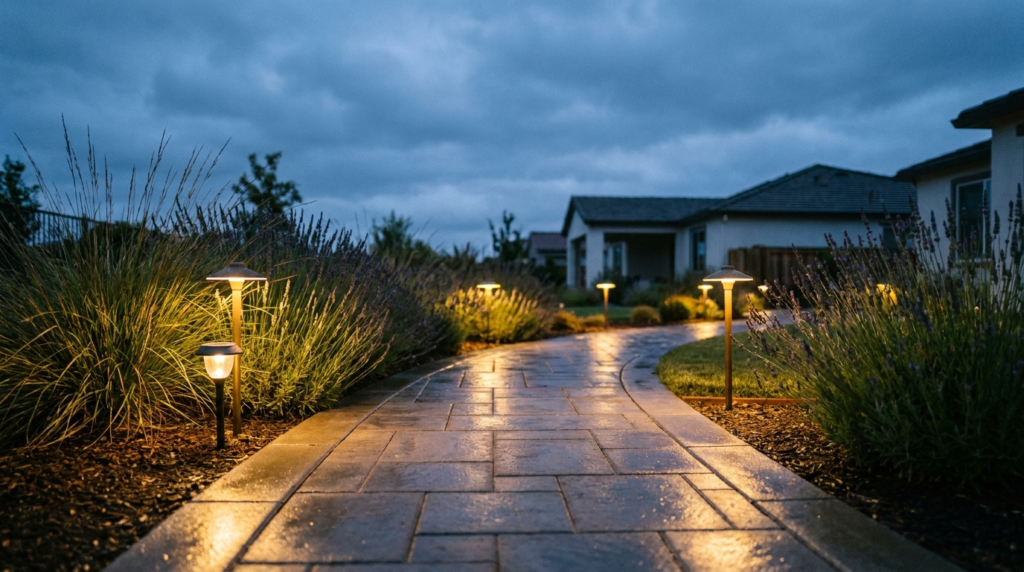
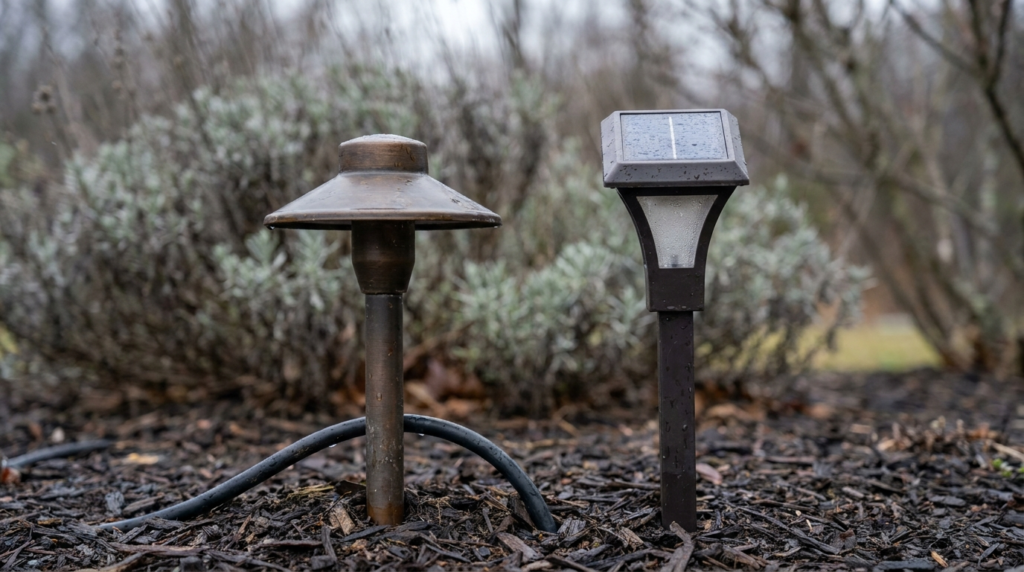
The difference is the power source. Low voltage lights draw electricity from your home through a transformer and buried cable, while solar lights charge a small battery from a panel during the day and use that stored energy at night.
That one difference drives almost everything else. Low voltage needs planning: a transformer, cable runs, and connections. In return, the light does not depend on the weather. Our outdoor lighting page covers how we approach wiring and fixtures, so we will not go deeper on transformers and cable length here.
Solar needs almost no setup. You push a stake into the ground. In return, each fixture is a small, self-contained system, so its brightness and run time depend on how much sun that one panel received.
Several lighting guides agree on the general pattern. Solar fixtures are usually dimmer than wired ones, and low voltage is described as steadier for larger, permanent designs. Solar gets credit for easy placement and no wiring. Those are fair points on both sides.
When you weigh low voltage vs solar lighting, keep the power source in mind first. Everything else, from brightness to upkeep, follows from it. Wired systems also need a weatherproof outdoor outlet with GFCI protection, and one home-improvement guide notes that an electrician is needed for the transformer hookup. Solar skips that step, which is its real advantage.
The winter problem nobody mentions about solar
Solar lights are weakest right when the night is longest. In winter, the days are shorter and the sun sits lower, so each panel collects less energy, and the battery has to cover more hours of darkness.
General energy guidance says solar fixtures need direct light, and that a spot with less sun than expected will run fewer hours per night. It also notes that run time changes with the season and sky, and can drop noticeably in winter unless the system was sized for that season. One lighting company makes the same point with a simple example: a solar light that looks fine in August can look genuinely dim by January. Treat that as one company’s view, not a test result.
That is why low voltage vs solar lighting looks like a close call in July and a clear one in December. The same fixture, in the same spot, can behave very differently across the year. Short winter days and stretches of overcast sky are the usual cause, and a bigger panel or battery only helps so much.
Shade makes it worse. A tree, a fence, or a roofline that barely matters in June can block a low winter sun for most of the day.
Here is what helps, in plain steps:
- Put the panel where it gets sun. If the fixture sits in shade, use a model with a separate panel and place only the panel in the light.
- Wipe the panel. Dust, leaves, and film block charging.
- Choose a larger battery. Guides suggest higher-capacity batteries for winter use, since weak charging also wears batteries down faster.
- Keep solar decorative. Use it where a dim night or an early shutoff will not matter.
- Use low voltage where light must be reliable. Paths, steps, and entries fit that description.
So here is the question to ask any seller: “How many hours of light should I expect on a short winter day, and what happens when the battery weakens?” A clear answer tells you a lot. A vague one tells you more.
Not sure which parts of your yard need dependable light? Tell us about your space.
Low voltage vs solar lighting: a guide by situation
Instead of asking which type is better, ask what each spot needs. The table below sorts common situations by what the sources support. It is a starting point, not a verdict.
| Situation | Low voltage | Solar | Question to ask |
|---|---|---|---|
| Main path or steps | Steady output on any night, once powered and wired | Possible, but run time can shrink in winter | Will this spot be dark and uneven if the light quits early? |
| Accent on a tree or wall | Better control over aim and brightness | Fine for a soft, decorative glow | Do I want a dramatic effect or just a hint of light? |
| Far corner with no outlet | Needs a cable run to reach it | No wiring needed, a good fit | Does this corner get real sun in winter? |
| Seasonal or decorative spot | More setup than the spot may deserve | Easy to place and move around | Will I want to rearrange this later? |
| Shaded area under trees | Not affected by shade | Charging suffers without sun on the panel | Can the panel sit somewhere sunny, away from the light? |
Where each one makes sense (and when neither does)
Low voltage fits the places where light has to be there every night. That means walkways, steps, and the path from the driveway to your front door. If someone could trip, you want a light that does not depend on yesterday’s weather.
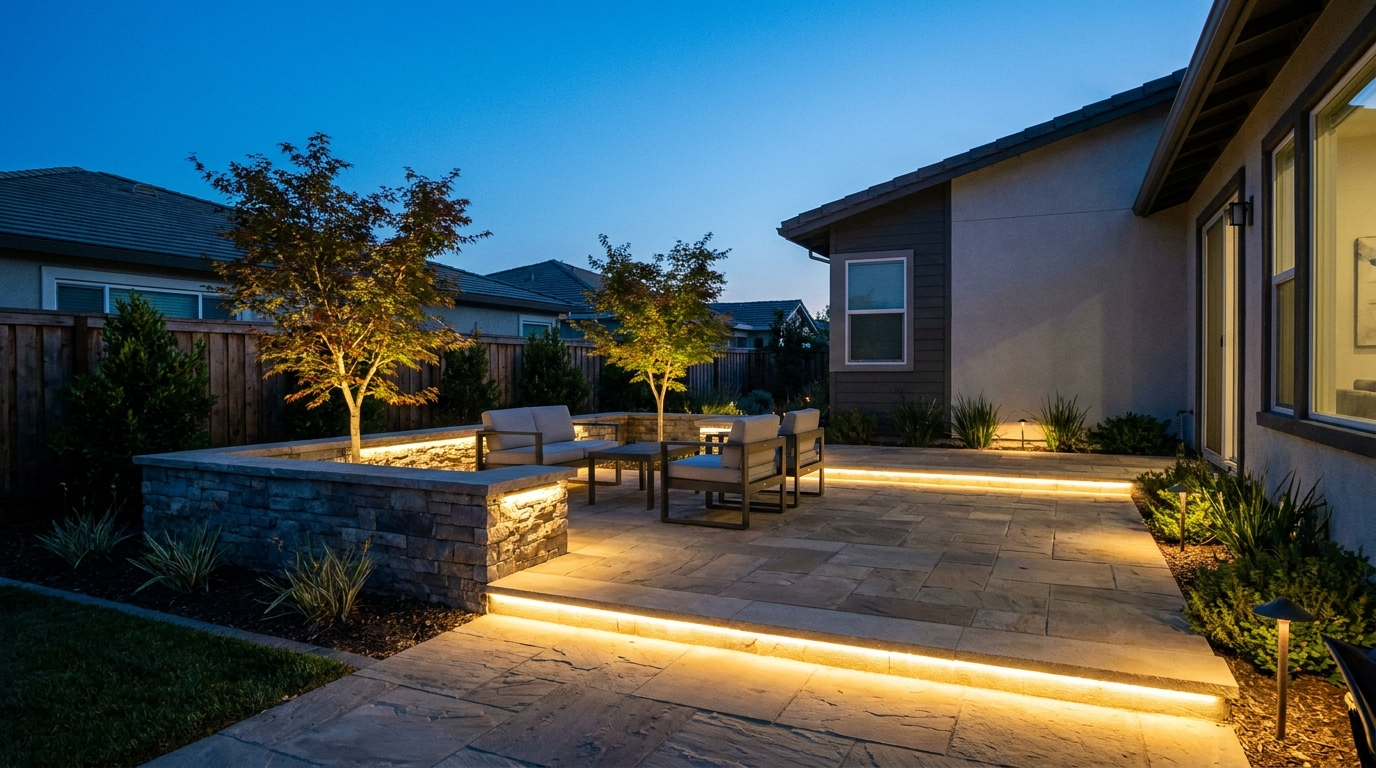
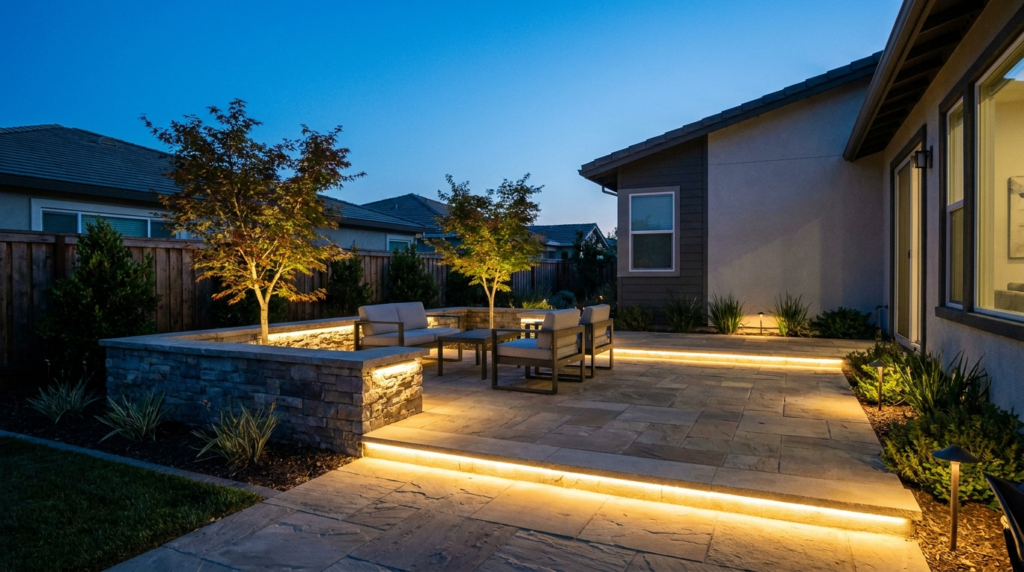
It also fits larger, permanent layouts. Picture a patio in Walnut Creek with a seating area, a planter wall, and two trees. Wired lights let you balance all of that from one system and add fixtures later.
Solar makes sense in smaller, lower-stakes spots. A decorative accent by a flower bed works. So does a far corner with no outlet nearby. It also works as a low-commitment way to test where you actually want light before building a full system. Our walkway pavers page shows the kinds of paths people usually light.
Many homeowners end up with a mix. A mixed layout is a sensible answer to the low voltage vs solar lighting debate, as long as each type does the job it handles best. Wired light covers the safety spots. Solar lights add small touches where running cable would not be worth the effort. If you have a retaining wall or a raised planter, wall-mounted fixtures are another place to compare both options.
Now the part most comparisons skip. Sometimes neither is the right call yet.
- Your landscaping is about to change, and fixtures would end up in the wrong place.
- You are planning a patio, retaining wall, or new walkway. Wiring is easier before the pavers go in than after.
- You have no clear idea which areas need light, so you would be guessing.
In those cases, sketch the plan first. If you are building new hardscape, our guide on patio pavers explains how lighting fits into the layout.
Example: a side path in Hercules
Imagine a side path in Hercules that leads from the driveway to a back gate. A tree shades half of it, and there are three steps near the gate. The homeowner starts with solar stakes along the path because they are simple.
In summer, they look fine. By December, the shaded half barely charges, and the lights near the steps fade early in the evening. The steps are the part that matters most, and that is where the light quits first.
The fix is not to throw everything out. A sensible plan would put low voltage along the steps and the shaded stretch, then keep a few solar accents where the sun actually reaches. Each type covers the job it is good at. Your yard will differ, but the thinking transfers.
Notice what changed in that plan. The homeowner stopped asking which type is better and started asking which spots can afford a dim night. That shift is the whole point of comparing low voltage vs solar lighting for your own property.
Frequently asked questions
Is low voltage better than solar for landscape lighting?
It depends on the job. Low voltage is generally described as steadier and better for permanent designs, since it draws from your home’s power instead of a small battery. Solar is easier to place and works where wiring is a hassle. Many yards use both, with low voltage for paths and steps and solar for decoration.
Do solar landscape lights work in winter?
Yes, they usually work, but not as long or as bright as in summer. Short days and overcast skies reduce charging, and shade can make it worse. A solar light placed in full sun with a clean panel will do better than one under a tree. Expect fewer hours of light on a short winter day, and plan for that.
How much upkeep does each type need?
Solar lights need clean panels, good placement, and eventually new batteries, since weak charging wears them down. Low voltage needs a check on the cable, the connections, and the fixtures now and then. Neither is hands-off. The difference is that solar upkeep repeats at every fixture, while low voltage centers on one system.
Why do solar lights turn off early or look dim?
Usually the battery did not get enough charge. That can come from shade, a dirty panel, short winter days, or a battery that has weakened over time. A small panel also limits how much energy each fixture can store. Moving the panel into the sun and cleaning it are the easiest first steps.
What affects the price of each option?
We do not quote numbers in articles, because every yard is different. The main factors are the type of power source, the number of fixtures, the length of cable runs, the controls you want, and the installation work involved. Walk through those with a pro, and you will see where your project falls. You can ask us for a free estimate on the contact page.
What should I ask an installer before I decide?
Ask how the system will be powered and who handles the electrical connection. Ask how many hours of light to expect on a short winter day. Ask what happens when a battery or a fixture fails, and how the layout can grow later. If you want more background, see our FAQ page.
Your next step
Walk your yard after dark this week. Mark the spots where you would feel the difference if the light did not come on: steps, turns, gates. Those are your low voltage candidates. Everything else is a good candidate for solar, or for nothing at all.
When you are ready to compare, the low voltage vs solar lighting decision gets easier with a plan in hand. Contact Legacy System Pavers for a free estimate, and we will help you sort out which spots need what. You can also see recent work on our Instagram and Facebook pages, or read what past customers say on our reviews page and our Thumbtack profile.