Thinking about lighting your yard? Contact our team and tell us about your paths, patio and trees. We will talk through what makes sense for your space.
Table of Contents
- How Do You Plan Landscape Lighting in the Bay Area?
- What Are the Four Layers of a Landscape Lighting Design?
- Why Do the Last Lights on a Run Look Dim?
- Which Code and License Questions Should You Ask About Landscape Lighting Bay Area Projects?
- Where Does Landscape Lighting Make Sense, and When Should You Wait?
- What Does a Lighting Project Look Like? A Hypothetical Example
- What Changes the Cost of a Lighting Project?
- Frequently Asked Questions
- What is the difference between low voltage and line voltage lighting?
- Do I need a permit for landscape lighting in California?
- What changes as a lighting system ages?
- Why do some fixtures look dim, and how many can one transformer run?
- What factors affect the cost of landscape lighting?
- What should I ask a professional before hiring?
- Next Steps for Landscape Lighting Bay Area Homeowners
Direct Answer: Landscape lighting Bay Area homeowners can trust starts with a layered plan, a correctly sized transformer and cable layout, fixtures that satisfy whatever energy-code rules your city applies, and a licensed professional who can explain which parts of the job need permits.
Search for landscape lighting Bay Area homeowners use and you mostly find fixture catalogs and contractor ads. Neither explains how a system is actually planned. Words like low voltage, line voltage, transformer and voltage drop get tossed around as if everyone already knows them.
This guide covers three things. First, how a good design is built in layers. Second, why a poorly planned system leaves the last lights on a run weak. Third, which code and license questions to put to your city and your installer, plus what moves the cost, with no numbers attached.
We build paver patios, walkways and driveways across the Bay Area, and lighting is often the finishing layer on those projects. Our outdoor lighting page breaks down the kinds of lighting we install. Here we stick to planning, so you can judge any proposal, ours included.
How Do You Plan Landscape Lighting in the Bay Area?
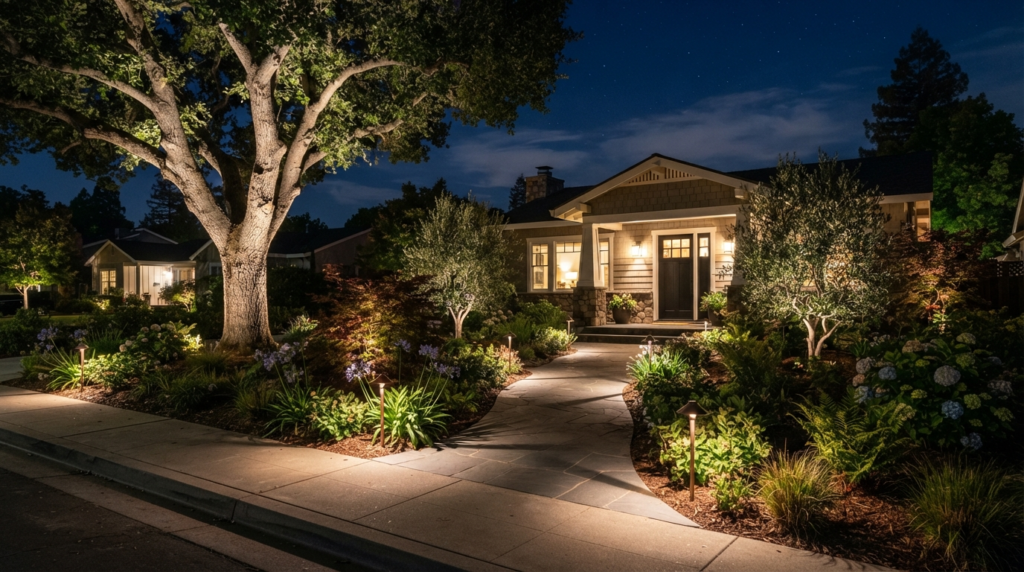
You plan it by deciding what each light has to do before you pick a single fixture. A path needs light on steps and edges. A tree needs a different kind of light than a dining table does. Walk your yard at dusk, mark the three or four places where you walk or sit after dark, and rank them.
Kichler, a fixture maker, advises in a Lawn & Landscape article to start with accent points and then fill in with path light and softer light around them, keeping the layers balanced. It also suggests placing fixtures so they stay out of the way of mowing and do not cause glare, and using several lower-output fixtures instead of a few strong ones. That is manufacturer guidance, so treat it as a sound starting point, not a rule.
Planning landscape lighting Bay Area style often means dealing with sloped lots, narrow side yards and mature trees. Each one changes where a fixture can sit and how long a cable run gets. A rough sketch of your yard, with distances, makes every later step easier.
What Are the Four Layers of a Landscape Lighting Design?
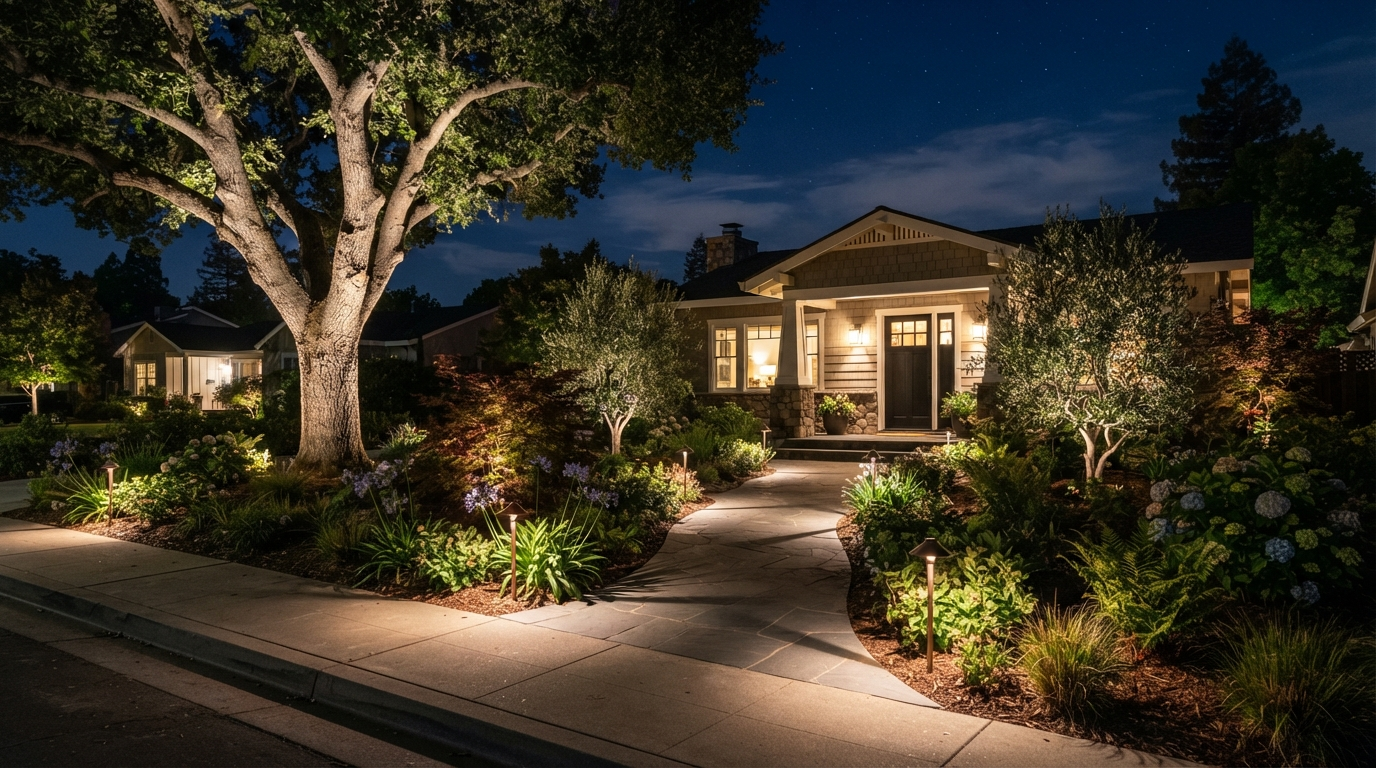
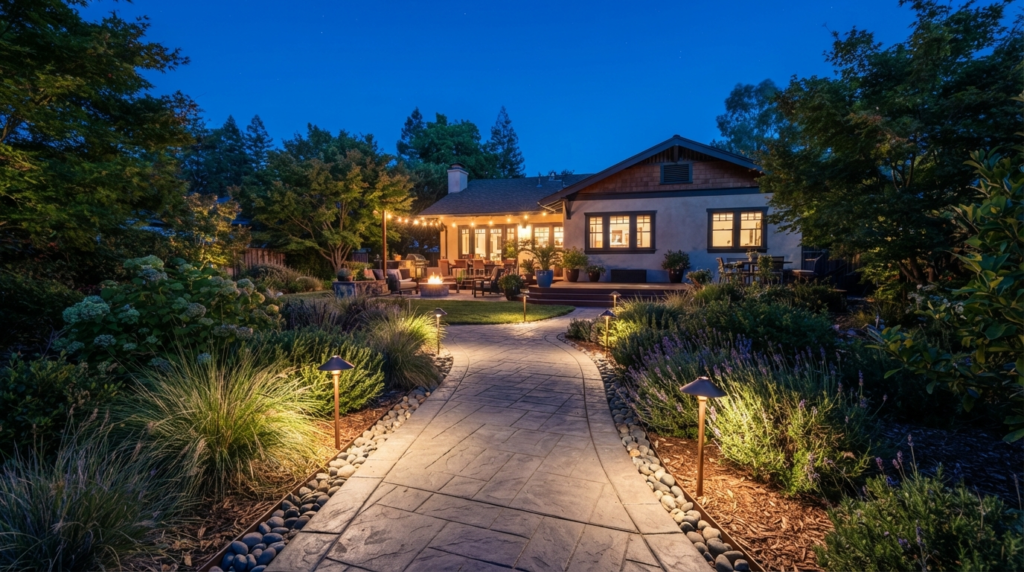
A layered design uses four kinds of light: path lights, accent lights, soft downlighting and patio or step lights. The table below shows what each layer does, what to watch for and what to ask your installer.
| Layer | What it does | Watch-out | Question to ask your installer |
|---|---|---|---|
| Path lights (walkways, driveway edges) | Show edges and steps so you can see where you are walking. | Glare in your eyes, and fixtures sitting in the path of a mower or edger. | Where will each fixture sit so the light lands on the ground, not in your eyes? |
| Accent and uplights (trees, walls, columns) | Create focal points. Kichler suggests starting with these and building outward. | Bright spots on bark or walls, and fixtures that end up in the wrong place as plants grow. | How will the aim and position change as the tree or shrub grows? |
| Downlights (soft light from above) | Wash a lawn, bed or seating area with gentle, spread-out light. | Mounting height and wiring up a tree or wall. Fixtures attached to the house may fall under energy-code lighting rules. | What is each fixture mounted to, and does that change the rules that apply? |
| Patio and step lights | Light seating areas, stairs and the edges of built-in walls. | Fixtures set into pavers or walls need planning before the paving goes in. | Can the wiring be routed before the pavers are laid, or through existing ones? |
You do not need all four layers. Many yards start with one or two and add the rest later. That later step is only easy if the transformer has room to spare, which is the next topic.
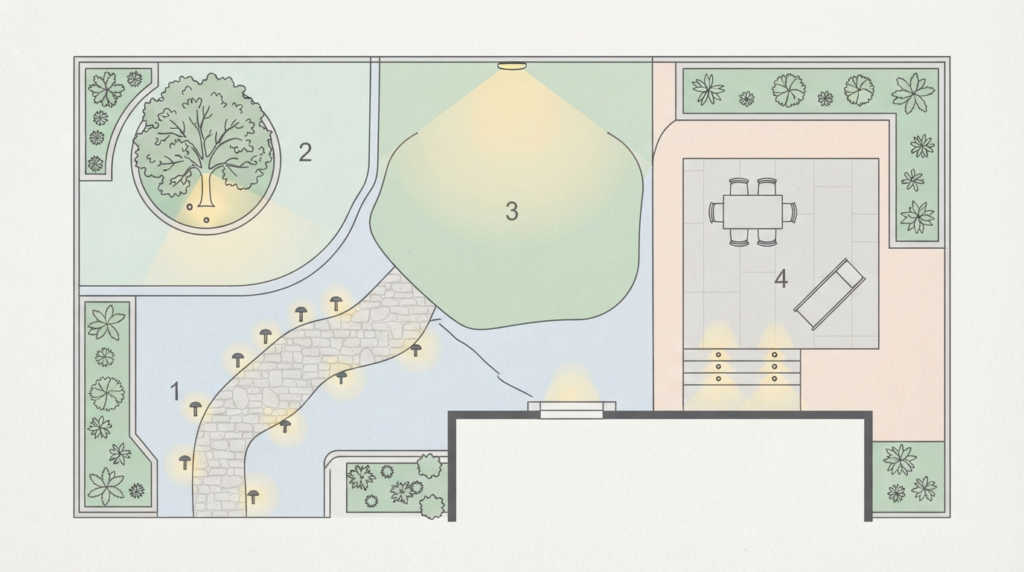
Not sure which layers fit your yard? Send us a message with a few photos and a rough idea of how you use the space after dark.
Why Do the Last Lights on a Run Look Dim?
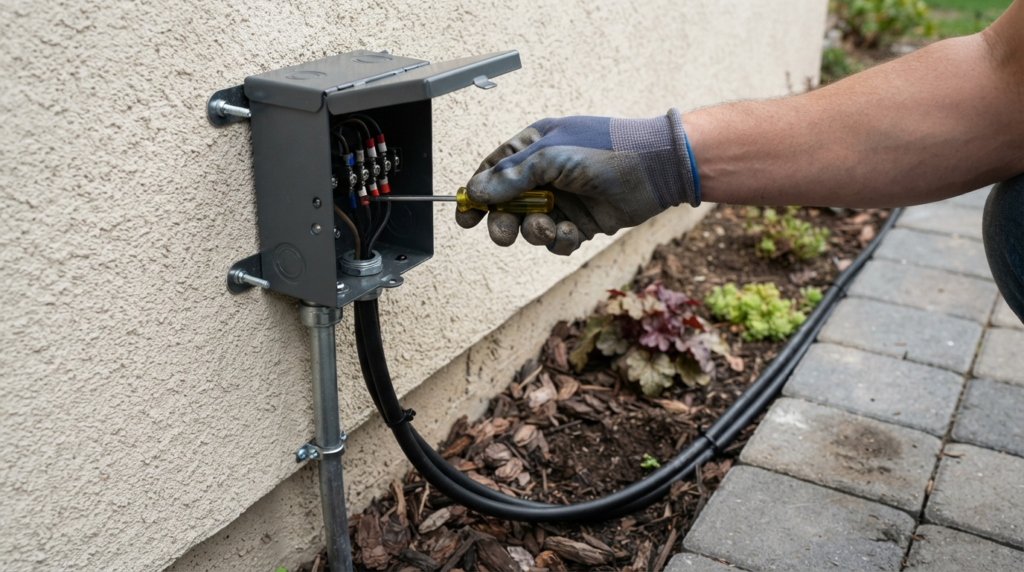
They look dim because of voltage drop: the farther power travels through cable, the less is left at the end. Most landscape systems run at low voltage, around 12 volts, and a transformer steps down the power from your home. According to EC&M magazine (Dick Liepold, 2003), the current at 12 volts is roughly ten times what a 120-volt circuit carries for the same power, so voltage loss shows up faster.
That article is old and was written in the halogen era, so use the principle and not the specifics. Ask your installer to confirm the details for current LED fixtures.
Poorly planned systems tend to share the same problem. The designer picked fixtures first and figured out the wiring second. The result is long cable runs, too many fixtures on one run and a transformer already near its limit. Kichler advises adding up the wattage of all the lamps, choosing a transformer rated close to that total, and keeping the load at no less than one third of the transformer’s capacity and never above its maximum. It also advises keeping voltage at the fixtures between 10.8 and 12 volts.
You can reduce voltage drop in several ways:
- Use thicker cable on longer runs.
- Keep runs short by placing the transformer near the middle of the layout.
- Add transformers or taps instead of stretching one cable across the whole yard.
- Put fewer fixtures on each run.
- Consider a loop layout. EC&M notes that loops give more even output.
- Leave spare capacity so you can add a fixture later without replacing the transformer.
Here is the question to ask before you sign anything: How much spare capacity will the transformer have, and how will you test the last fixture on each run? A confident, specific answer tells you the system was planned, not just installed.
Which Code and License Questions Should You Ask About Landscape Lighting Bay Area Projects?
Ask your city and your installer, because the answer depends on your location, your fixtures and how the system connects to your home. We are not able to tell you what the law requires for your yard, but we can point you to the right questions.
Energy code. California’s 2025 Energy Code (Title 24, Part 6) took effect on January 1, 2026, replacing the 2022 edition, according to EC&M’s reporting from October 2025. The California Energy Commission’s residential lighting compliance forms list requirements for outdoor lighting permanently mounted to a home or to other buildings on the same lot. Those include light sources marked JA8-2025 and specific control requirements. Ask which fixtures and controls apply to your project, and ask which code edition your city is using.
Permits. Rules vary by city and by scope. A system that plugs into an existing outlet is a different job from one that adds a circuit, connects to your home’s wiring or needs trenching. Ask your building department whether your scope needs a permit, and ask your installer who pulls it.
License. The Contractors State License Board (CSLB) describes the C-10 electrical classification as covering the installation of wiring, fixtures and equipment that use electrical energy. Its C-27 landscaping classification does not mention lighting or electrical work in its description. We did not find a CSLB statement on which class covers low voltage landscape lighting. So ask for the contractor’s license number and classification, look it up on the CSLB website, and ask who makes the electrical connection. We are glad to answer those questions for our own projects.
Where Does Landscape Lighting Make Sense, and When Should You Wait?
It makes the most sense where you move or gather after dark. These are the situations where lighting tends to earn its place:
- Walkways and steps. A side path in Hercules with uneven steps is a good example of a spot where light helps you see edges.
- Patios and seating areas. A paver patio in Walnut Creek is far more useful at night when the table and the steps are lit.
- Trees and walls. A mature tree in Los Altos can anchor the whole view from your window if it is lit well.
If you are about to pave, tell your installer first. Wiring routes are much easier to plan before the pavers go in. Our page on patio pavers covers how those surfaces are built.
When lighting may not be the right move yet:
- Your landscaping is about to change. New plants, walls or paving will shift where fixtures belong. Wait, or plan the wiring routes now and add fixtures later.
- Your home’s electrical circuit needs work first. Fix that before adding a lighting system that depends on it.
- You only need one light. A single fixture on a porch may not need a full system.
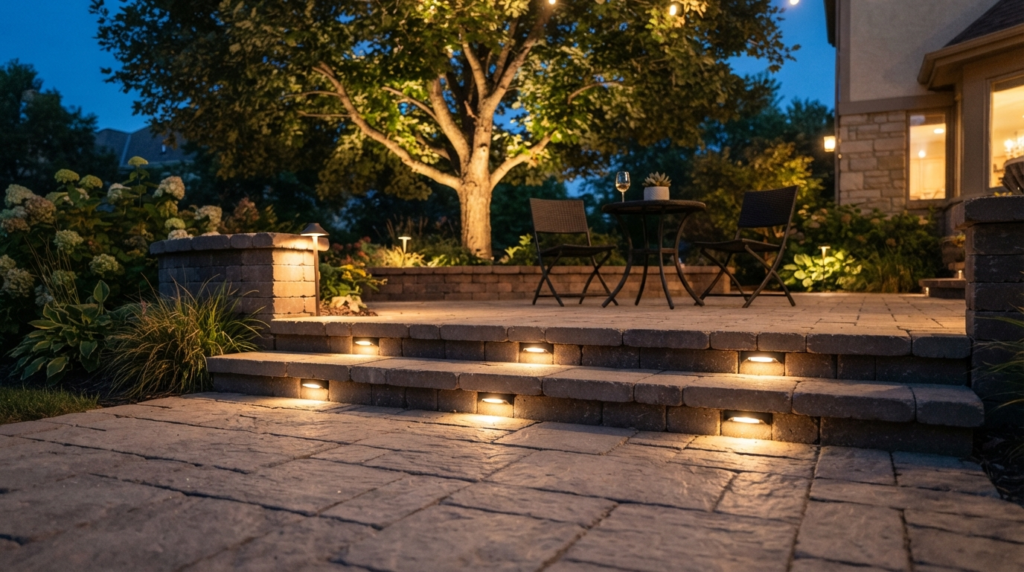
What Does a Lighting Project Look Like? A Hypothetical Example
Here is a made-up scenario, not a past client. Picture a homeowner in Pleasant Hill with a paver patio, a side walkway with three steps and a large tree in the back corner. They want to use the patio on weeknights and stop tripping on the steps.
A sensible process follows the same five stages our outdoor lighting page describes: a consultation and estimate, a lighting plan, wiring and prep, installation, and a final walkthrough. In this scenario, the plan would put an uplight on the tree first, then step lights and a few path lights, then soft light over the seating area. The wiring layout would group fixtures into short runs and leave spare transformer capacity. At the walkthrough, someone would check the last fixture on each run to confirm it matches the first.
What Changes the Cost of a Lighting Project?
The scope of the project changes the cost more than any single fixture. We do not publish numbers here, because a fair figure depends on your yard. These are the factors that move it:
- Number of fixtures and how many layers you want.
- Cable length and number of transformers needed to reach every fixture.
- Trenching versus routing through existing pavers or hardscape.
- Access and slope of the yard.
- Controls, such as a timer, a light sensor or app control.
- Fixture type and material, including how they hold up outdoors.
- Design scope and whether electrical work on the house is needed.
Ask every contractor to list these items in writing. That is how you compare two proposals fairly. If you want a written scope for your own yard, request an estimate and we will go through it with you.
Frequently Asked Questions
What is the difference between low voltage and line voltage lighting?
Low voltage landscape lighting runs on about 12 volts, with a transformer stepping down power from a 120-volt source. Line voltage fixtures connect directly to your home’s full-voltage wiring. Low voltage systems depend on careful transformer sizing and cable planning. Line voltage work is electrical work on your home’s circuits, so ask who is licensed and permitted to do it.
Do I need a permit for landscape lighting in California?
It depends on your city and the scope of the work. Plugging in a transformer is a different job from adding a circuit or connecting to your home’s wiring. Call your city’s building department and describe the scope. Then ask your installer who is responsible for any permit.
What changes as a lighting system ages?
Your yard changes more than the lights do. Plants grow into beams, soil work can shift fixtures, and timer settings may need adjusting as evenings get shorter or longer. If the last fixture on a run starts to look dimmer than the first, the wiring or transformer load deserves a closer look.
Why do some fixtures look dim, and how many can one transformer run?
Dim fixtures usually point to voltage drop or an overloaded transformer. How many fixtures one transformer can run depends on the combined wattage of the lamps. Kichler advises totaling that wattage and choosing a transformer rated close to the total, within its limits. Your installer should show you this math for your layout.
What factors affect the cost of landscape lighting?
The main factors are fixture count, cable length, number of transformers, trenching versus routing through existing hardscape, yard access, controls and fixture materials. Design scope and any electrical work on the house also matter. A written scope that lists each item makes it easy to compare proposals.
What should I ask a professional before hiring?
Ask for the license number and classification, and verify it on the CSLB website. Ask who makes the electrical connection and who pulls any permit. Ask how much spare capacity the transformer will have and how the last fixture on each run will be tested. Finally, ask what the fixtures are made of and how they hold up outdoors.
Next Steps for Landscape Lighting Bay Area Homeowners
A good lighting plan comes down to a few clear steps. Decide what each light must do, build the design in layers, size the transformer and cables with room to spare, and put the code, permit and license questions to your city and your installer before work starts. Our FAQ page answers general questions about how we work.
You can see finished paver work on our Instagram and Facebook pages. Past-client reviews, including our Thumbtack profile, mostly describe paver and turf projects, so ask us for details about lighting specifically.
If you are ready to start planning landscape lighting Bay Area yards can enjoy after dark, contact Legacy System Pavers at 925-666-3008 or info@legacysystempavers.com. We are open Monday through Saturday, 9:00 AM to 5:00 PM.