- Direct Answer
- What Is Zone 0 Under California’s New Defensible Space Law?
- Artificial Turf Defensible Space California: What the Final Zone 0 Rule Says
- The Problem With Artificial Turf No One in the Industry Likes to Mention
- How Local Fire Departments Are Already Handling Turf in Zone 0
- Fire-Conscious Ground Cover Options for the First Five Feet
- Where Artificial Turf Still Makes Sense on a Bay Area Property
- Is artificial turf the same as a fire-resistant lawn alternative in Zone 0?
- Can I install artificial turf right against my house in a Very High Fire Hazard Severity Zone?
- Does turf near a house still need fire-safety maintenance?
- Why doesn’t the artificial turf industry agree on whether turf is fire safe?
- What affects the cost of making the first five feet of a yard Zone 0 compliant?
- What should I ask a contractor before installing turf near my house?
Direct Answer: California’s new Zone 0 defensible space rule never explicitly names artificial turf, so artificial turf defensible space California compliance still depends on how your local fire department applies the general no-combustible-material standard within the first five feet of your home.
If you’ve searched for artificial turf defensible space California rules recently, you’ve probably run into three overlapping terms: Zone 0, the ember-resistant zone, and defensible space. Some homeowners also confuse Zone 0 with the older Fuel Modification Zones that certain Southern California fire departments already enforce, which is a separate, sometimes stricter layer of rules on top of the new statewide standard.
The confusion matters right now because California’s Board of Forestry and Fire Protection just approved the state’s first Zone 0 regulation, and it changes what is allowed within five feet of your home. If you’re weighing artificial turf for that space, whether to replace a dying lawn strip or to finish off a paver patio, you need a straight answer before you spend money on installation.
This guide covers what the new Zone 0 rule actually requires, why artificial turf sits in a genuine gray area instead of a clean yes or no, and what our crews at Legacy System Pavers recommend for Bay Area homeowners who want a fire-conscious yard without guessing at compliance. If you’d rather skip the research and get a plan for your specific property, reach out to our team and we’ll walk through it with you.
What Is Zone 0 Under California’s New Defensible Space Law?
Zone 0 is the five-foot ember-resistant buffer around every structure that California’s Board of Forestry and Fire Protection just turned into an enforceable statewide rule. The legal basis goes back to Assembly Bill 3074 in 2020, updated by Senate Bill 504 in 2024, both of which amended Public Resources Code 4291 to require this new zone alongside the existing Zone 1 and Zone 2 defensible space rules.
Governor Newsom’s Executive Order N-18-25 pushed the Board of Forestry to finish the rulemaking process, and the Board approved the final regulation text on August 19, 2026. It still needs a short legal review from the state’s Office of Administrative Law, with an effective date expected around the end of September 2026. The rule applies to properties in State Responsibility Areas and to Very High Fire Hazard Severity Zones inside city and county jurisdictions.
New construction in a mapped high-hazard zone has to comply as soon as the rule takes effect. Existing homes get a phase-in period instead of an immediate deadline, though reported timelines have shifted throughout the rulemaking process, so confirm the current compliance window with your local fire department rather than relying on an older estimate. One detail worth knowing: the rule splits the five feet into two rings, a fully noncombustible ring immediately against the wall and a slightly more flexible ring for the rest of the zone.
Artificial Turf Defensible Space California: What the Final Zone 0 Rule Says
The Zone 0 rule the Board of Forestry approved does not name artificial turf anywhere in its text, and that is the single most important thing to understand before you install it inside the five-foot zone. The rule spells out a general standard instead: no landscaping material likely to be ignited by embers, with an explicit list that covers natural grass, ornamental and native plants, shrubs, fallen leaves and needles, weeds, and combustible mulch like bark or wood chips.
Artificial turf simply isn’t on that list, in either direction. That gap means treatment comes down to how an individual inspector applies the general combustibility standard to a synthetic product, not to a clear rule you can point to. Anyone who gives you a flat yes or no on artificial turf defensible space California compliance right now is guessing, not quoting the regulation. Lawns and low ground covers under about three inches, small non-woody plants up to eighteen inches, and potted plants in noncombustible containers are addressed directly in the final rule, which only sharpens the contrast with how silent it stays on turf.
The Problem With Artificial Turf No One in the Industry Likes to Mention
Plenty of turf installers point to flame-spread testing, like ASTM E108, to market their product as wildfire safe. That testing is real, and it does show that quality turf generally doesn’t ignite and spread an open flame the way dry natural grass does. Char instead of combustion is a genuine advantage in a lot of fire scenarios.
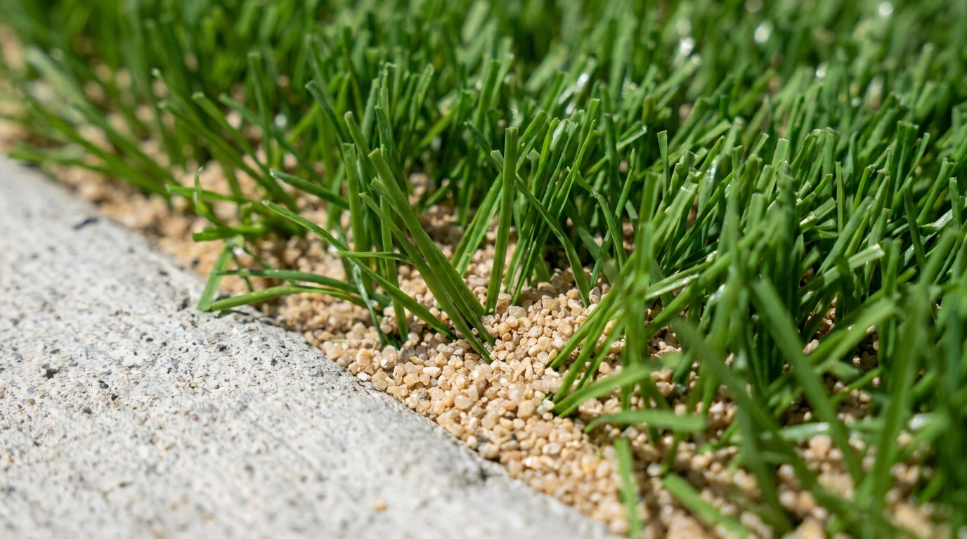
But Zone 0 isn’t primarily worried about flame spread. It’s worried about sustained radiant heat and direct ember contact right next to a structure, and that’s a different failure mode. Petroleum-based turf fibers can melt, shrink, and release fumes under that kind of heat exposure, and infill matters a lot here. Crumb rubber infill behaves differently than sand or zeolite infill once heat is involved. That distinction rarely makes it into a sales conversation.
Here’s how to reduce that risk if turf is part of your plan:
- Choose a product with documented ASTM E108 or equivalent fire-test results, not just a marketing claim
- Ask specifically about infill type, since sand and zeolite generally outperform crumb rubber under heat exposure
- Keep the turf edge bordered by noncombustible material rather than letting it meet the wall directly
- Remove fallen leaves and debris from the surface on a regular schedule, since trapped organic material changes the risk profile
Before you commit to turf anywhere near your home, ask your installer whether the specific product and infill combination have documented fire-test results, and whether your local fire department currently treats synthetic turf as compliant inside the five-foot zone.
How Local Fire Departments Are Already Handling Turf in Zone 0
Local fire authorities enforce defensible space rules and keep real flexibility to tailor them to their own community, and several jurisdictions already went further than the state’s silence on turf. Ventura County’s fire protection district, for example, explicitly excludes artificial turf from the hardscape-only zone equivalent to Zone 0 in its own standard. Los Angeles County treats artificial turf as a separate limitation within its longer-running Fuel Modification Plan rules, apart from the new statewide Zone 0 language entirely.
That pattern matters across our own Bay Area service area. Hillside communities in the North Bay wine country and the East Bay hills carry real wildfire mapping, and homeowners there should expect their city or county to potentially hold a stricter line on turf than the still-forming state rule does. Flat suburban lots elsewhere in the region are far less likely to fall inside a mapped Very High Fire Hazard Severity Zone in the first place, which changes the calculation considerably. Not sure what your specific city currently allows? Contact our team and we’ll help you sort out state and local requirements before you buy any material.
Fire-Conscious Ground Cover Options for the First Five Feet
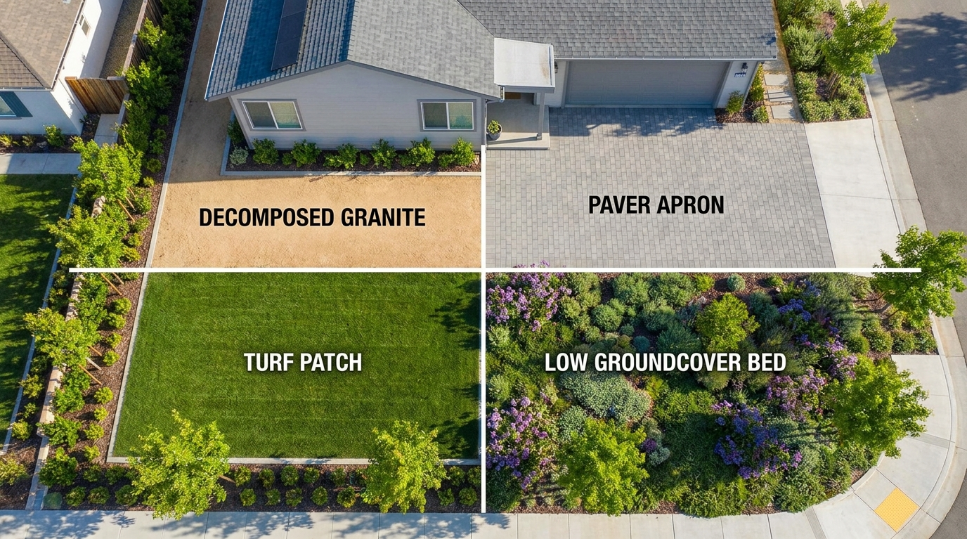
Every material choice for the first five feet trades off differently between fire safety, water use, and how much upkeep it demands. The table below breaks down where each option currently stands.
| Material | Current Zone 0 Status | Typical Placement | Common Mistake |
|---|---|---|---|
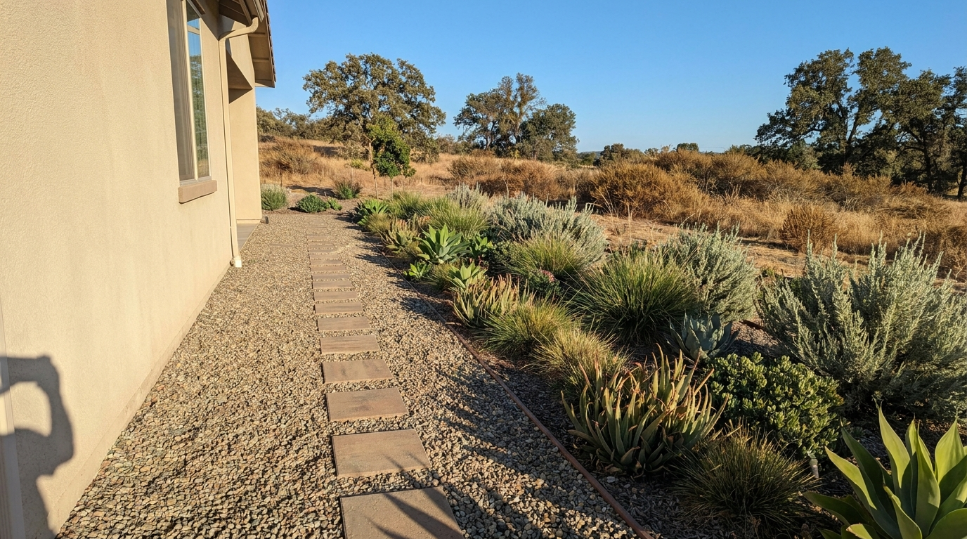
| Gravel or Decomposed Granite | Recognized noncombustible option | Immediately against foundation walls | Letting organic mulch or leaf litter build up on top over time |
| Concrete or Paver Apron | Recognized noncombustible option | Foundation perimeter and walkway edges | Leaving gaps at joints that trap debris |
| Standard Artificial Turf | Not addressed in the final rule; often treated as combustible by inspectors | Better suited to Zone 1 or backyard areas away from the structure | Assuming any turf automatically satisfies Zone 0 |
| Fire-Rated Turf with Sand or Zeolite Infill | Not addressed in the final rule; some jurisdictions still restrict it regardless of rating | Zone 1 edges, play areas, pool surrounds | Relying on product marketing instead of confirming with the local fire department |
| Low, Well-Irrigated Groundcover Under 3 Inches | Addressed directly and allowed under the newly approved rule | Outer portion of the five-foot zone, away from the wall | Letting it dry out or exceed the height limit |
Our guide on turf installation walks through infill choices and edging options in more detail if you decide synthetic turf fits somewhere on your property.
Where Artificial Turf Still Makes Sense on a Bay Area Property
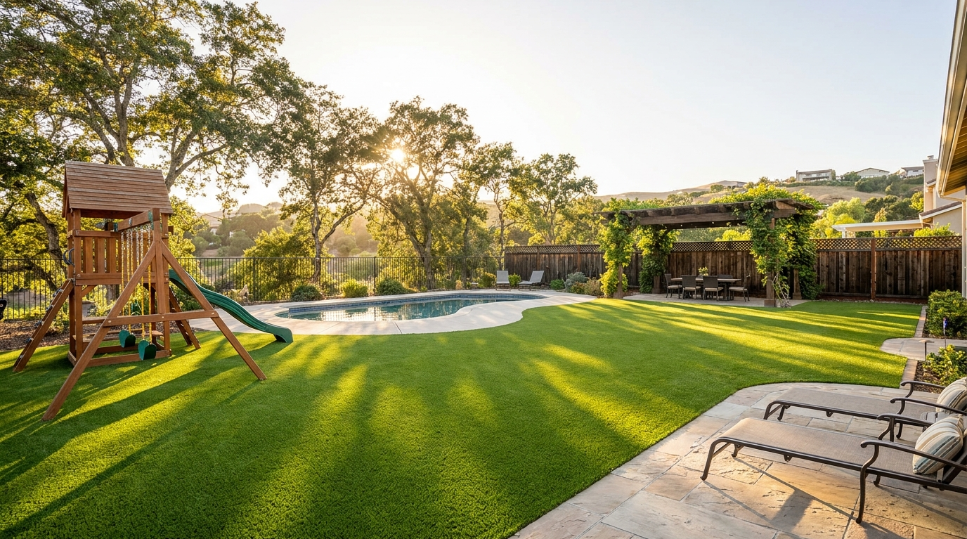
Artificial turf still makes plenty of sense once you move past the five-foot line. Backyard lawn replacement, pool surrounds, and kids’ play areas are all strong applications, especially anywhere outside a mapped Very High Fire Hazard Severity Zone, which covers most of the flat suburban lots across our service area. Side yards and lower-risk properties get the water savings and year-round color without any Zone 0 ambiguity attached.
Turf makes far less sense directly against an exterior wall in a mapped high-hazard zone, under an egress window, or butted up against an attached wood deck or staircase. In those specific spots, a noncombustible material buys you certainty. Everywhere else on the property, that certainty matters a lot less.
Consider a hillside property we worked on recently in Contra Costa County. The homeowners wanted to replace a strip of bark mulch running along their foundation with something greener than plain gravel. Instead of installing turf right against the wall, our crew laid a decomposed granite border across the innermost two feet and reserved a small turf accent for the outer edge of the five-foot zone, paired with a fire-rated product and sand infill. That layout gave them the color and texture they wanted without leaving any ambiguity for a defensible space inspection.
Homeowners who leave us feedback on Google often mention wanting a yard that looks finished without second-guessing every material choice, which is exactly the kind of clarity this five-foot zone requires. You can read more of that feedback on our Google Business Profile, and browse recent installations on our Instagram page.
FAQ
Is artificial turf the same as a fire-resistant lawn alternative in Zone 0?
No, treat them as different categories. Artificial turf is a synthetic, petroleum-based product, while a fire-resistant lawn alternative usually refers to the low, well-irrigated groundcover under the height limit the new Zone 0 rule allows. Because the final rule doesn’t name turf specifically, don’t assume marketing terms like fire-resistant turf carry the same legal standing as the ground covers the rule spells out. If lawn-like coverage inside the five-foot zone matters to you, ask your local fire department whether they treat synthetic products the same as the height-limited living groundcover option.
Can I install artificial turf right against my house in a Very High Fire Hazard Severity Zone?
Right against the foundation wall is the riskiest placement, since that inner ring of Zone 0 gets the strictest noncombustible standard under the new rule. Some local fire departments, including jurisdictions like Ventura County, already exclude turf from that immediate zone regardless of the product’s fire rating. If your property sits in a mapped Very High Fire Hazard Severity Zone, confirm with your local fire authority before installing turf within the first five feet, and consider gravel, decomposed granite, or a paver apron there instead.
Does turf near a house still need fire-safety maintenance?
Yes, even turf placed safely outside Zone 0 needs regular upkeep to stay low-risk. Clear fallen leaves, pine needles, and other debris off the surface, since trapped organic material can smolder even on a synthetic base. Check infill periodically, since sand and zeolite infill hold up differently over time than crumb rubber. Keep an eye on seams and edging near any wood fencing or structures, since gaps and lifted edges create places for embers to collect.
Why doesn’t the artificial turf industry agree on whether turf is fire safe?
The disagreement comes down to what “fire safe” is being measured against. Flame-spread tests like ASTM E108 mostly show turf doesn’t ignite and spread flame the way dry natural grass does, which is why some installers market it as a wildfire-safe upgrade. Regulators focused on Zone 0 are looking at a different risk, since sustained radiant heat and ember exposure can still melt, scorch, or release fumes from petroleum-based fibers and certain infill types. That gap between flame-spread testing and ember or radiant-heat performance is exactly why the new rule stayed silent on turf instead of issuing a blanket yes or no.
What affects the cost of making the first five feet of a yard Zone 0 compliant?
Cost mostly comes down to how much existing material needs to be removed, whether the ground needs regrading before new hardscape goes in, and which noncombustible material you choose, since gravel, decomposed granite, pavers, and fire-rated turf all involve different labor and material inputs. Properties with wood fencing, attached decks, or stairs inside the five-foot zone usually need extra work to meet the noncombustible-attachment requirement. A contractor can walk your specific property and outline which of these factors apply before you commit to a material.
What should I ask a contractor before installing turf near my house?
Ask whether they’ve reviewed your local fire department’s current defensible space requirements, not just the statewide Zone 0 rule, since local authorities can be stricter. Ask for documentation on the specific turf product’s fire-test rating and infill type if you’re considering turf anywhere close to the five-foot line. Ask how they’ll handle the noncombustible border where turf meets your home’s foundation. Ask what happens if your jurisdiction’s interpretation shifts before or after the rule takes effect, and whether they’ll help you adjust the installation later if needed.
The Bottom Line on Artificial Turf and Zone 0
California’s Zone 0 rule is finally real, but it leaves artificial turf in a gap the regulation never closed. Treat any confident yes or no you read elsewhere with some skepticism, and lean on gravel, pavers, or approved low groundcover for the five feet closest to your walls until your local fire department gives you clarity on synthetic turf specifically. Beyond that line, turf remains a strong, water-smart choice across most of the Bay Area.
Weighing artificial turf defensible space California requirements for your own property? Get in touch with Legacy System Pavers and we’ll help you plan a yard that looks good and holds up to inspection.